Most email campaigns fail before a single word gets read. The failure happens earlier - in the quality of the list, the logic of the segmentation, or the technical infrastructure handling the send. Marketers who focus exclusively on crafting compelling subject lines while neglecting list hygiene and deliverability are building on sand. The results show it: low open rates, climbing unsubscribe numbers, and campaigns that quietly disappear into spam folders.
Email marketing consistently delivers one of the strongest returns of any direct marketing channel, but that performance is not automatic. It depends on deliberate decisions made at every stage of the process - how contacts are acquired, how lists are maintained, how campaigns are structured, and which tools are trusted to handle delivery at scale. Some businesses choose to buy bulk emails as part of their initial acquisition strategy, which can work when paired with rigorous list hygiene, proper authentication, and a clear compliance framework.
This article covers the full operational picture: building mailing lists that attract genuinely interested subscribers, keeping those lists clean and deliverable, designing email campaigns that produce measurable results, selecting and using bulk email services correctly, and applying advanced techniques that compound performance over time. Whether you are building a program from scratch or troubleshooting one that has stalled, what follows is a practical, complete guide to getting email marketing right.
Understanding Email Marketing Fundamentals: Why Strategy Comes Before Send
Email marketing is a permission-based communication system, and that single characteristic separates it from almost every other digital channel. When someone subscribes to your list, they are granting access to a space - their inbox - that carries an implicit expectation of relevance and respect. Violate that expectation, and the consequences are swift: spam complaints, unsubscribes, and deliverability damage that affects your entire sending program, not just one campaign.
The channel's strength lies in directness. An email lands in a specific person's inbox without competing in an algorithmic feed or requiring paid placement. That directness is also its vulnerability: there is nowhere to hide when the content is irrelevant, the timing is off, or the list is poorly matched to the message. Performance is visible and measurable in ways that many other channels are not.
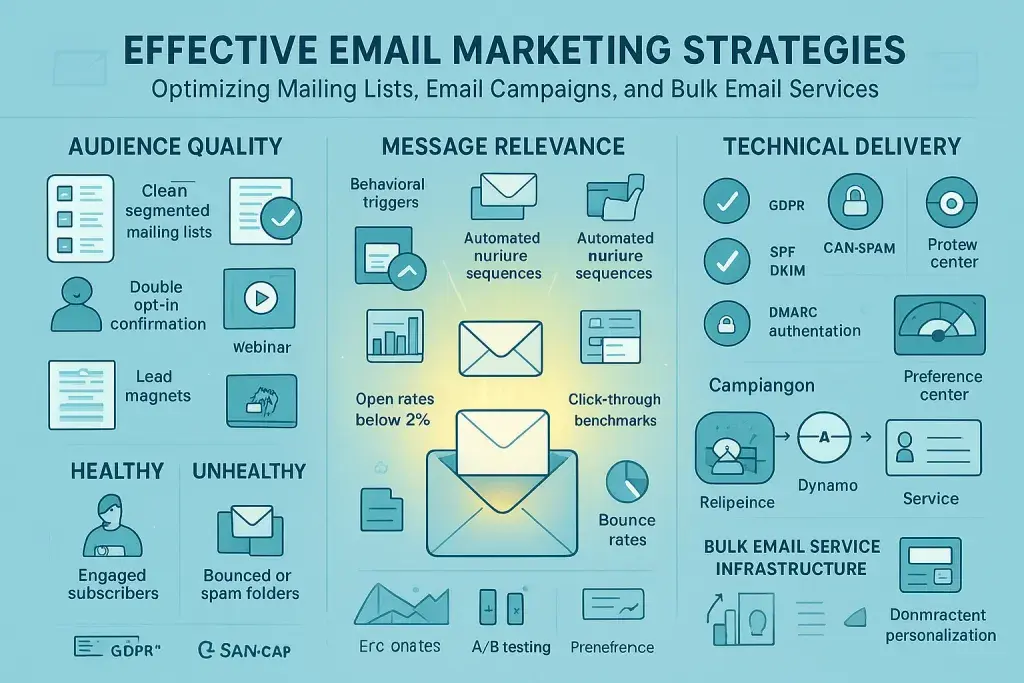
Three pillars support every high-performing email program. The first is audience quality - the health, composition, and engagement level of your mailing lists. The second is message relevance - how precisely your email campaigns speak to the specific needs and interests of each subscriber segment. The third is technical delivery - the infrastructure, authentication, and platform choices that determine whether your email reaches the inbox at all.
Most underperforming programs have a problem in at least one of these three areas. A beautifully written campaign sent to a degraded list achieves little. A well-maintained list receiving generic, untargeted messages produces mediocre engagement. And a relevant, well-segmented campaign sent through improperly configured infrastructure may never reach its audience. The three pillars are interdependent, and strategy must address all of them simultaneously.
Understanding this framework also clarifies where to invest first. Before testing new content formats or experimenting with send frequency, it is worth auditing list quality, confirming authentication setup, and verifying that basic segmentation is in place. Optimization built on a weak foundation produces diminishing returns. Optimization built on solid fundamentals compounds.
- Email delivers a strong return on investment compared to most digital marketing channels when executed with clean lists and relevant content
- Segmented campaigns consistently outperform non-segmented ones across open rates, click rates, and conversions
- Personalized subject lines produce meaningfully higher open rates than generic alternatives
- Average open rates vary by industry, typically ranging between 20% and 30% for well-maintained lists
Building and Growing High-Quality Mailing Lists
List size is not the same as list value. A smaller mailing list composed of people who actively want to hear from you will generate better results than a larger list padded with disengaged contacts, unverified addresses, and people who never explicitly agreed to receive your emails. The distinction matters not just for performance metrics but for deliverability: inbox providers watch engagement signals closely, and a list full of inactive subscribers drags down the reputation of your entire sending domain.
Building a high-quality list requires a deliberate acquisition strategy, ethical practices, and systems designed to capture genuine interest rather than raw volume.
Organic List Building Strategies That Attract Engaged Subscribers
Organic list building starts with a simple premise: give people a compelling reason to subscribe. That reason needs to be specific, immediately useful, and directly relevant to the audience you want to attract. Vague promises of "updates and news" rarely motivate sign-ups. Concrete, valuable offers do.
Lead magnets are the most reliable tool for organic list growth. A lead magnet is a resource or benefit offered in exchange for an email address. The most effective lead magnets solve a specific problem or answer a specific question that your target audience is already looking to address.
- Downloadable guides, templates, or checklists relevant to your niche
- Free webinar or video training series with email registration
- Exclusive discounts or early access offers for new subscribers
- Free trials or product samples accessible after sign-up
- Quizzes or assessments that deliver personalized results via email
- Curated newsletters positioned around high-value, hard-to-find information
Beyond the lead magnet itself, placement strategy determines how many visitors convert into subscribers. Forms embedded within high-traffic content pages, exit-intent overlays, dedicated landing pages, and social media profile links all serve as acquisition entry points. Testing different placements and form configurations allows you to improve conversion rates over time without changing your core offer.
Double opt-in - requiring subscribers to confirm their email address after initial sign-up - produces smaller lists but significantly higher quality ones. Confirmed subscribers are more likely to engage, less likely to mark your emails as spam, and more likely to remain active over time. For any program where email list management quality is prioritized over raw subscriber count, double opt-in is the right default.
List Segmentation: The Key to Relevance at Scale
Once contacts are on your list, treating them all identically is a missed opportunity with measurable consequences. Segmentation divides your mailing list into smaller groups based on shared characteristics, so each group receives more relevant communications. The improvement in engagement metrics from even basic segmentation is consistent and significant across industries.
Segmentation can draw on demographic data such as location, job title, or company size; behavioral data such as purchase history, email engagement, or browsing patterns; psychographic signals such as expressed interests or survey responses; and lifecycle stage such as new subscriber, active customer, or lapsed buyer. Each dimension offers a different lens for targeting, and the most effective programs combine multiple dimensions to create precise audience segments.
| Segmentation Type | Data Source | Example Use Case | Primary Benefit |
|---|---|---|---|
| Demographic | Sign-up form fields | Location-based promotions | Increased local relevance |
| Behavioral | Purchase or browsing history | Product recommendation emails | Higher conversion rates |
| Engagement-based | Open and click data | Re-engagement campaigns for inactive contacts | Improved deliverability |
| Lifecycle stage | CRM or email platform data | Onboarding series for new subscribers | Better subscriber retention |
| Psychographic | Surveys or preference centers | Interest-based newsletter content | Higher read rates and engagement |
Starting simple is entirely valid. Even splitting your list into two groups - customers versus non-customers, for example - produces more relevant campaigns than sending the same email to everyone. Sophistication can be added incrementally as data quality improves and your understanding of distinct audience segments deepens.
Compliance and Permission: Building Lists the Right Way
List building without a compliance framework is not just an ethical problem - it is a legal and operational one. Regulations governing commercial email, including the GDPR in Europe, the CAN-SPAM Act in the United States, and Canada's CASL, establish clear requirements around consent, transparency, and the right to unsubscribe. Non-compliance carries financial penalties that scale with the severity and scope of the violation.
Beyond legal requirements, compliance practices build the subscriber trust that drives long-term engagement. Subscribers who feel respected and in control of their inbox relationship are more likely to remain active, less likely to complain, and more likely to convert when the right offer reaches them.
- Obtain explicit consent before adding anyone to a mailing list - pre-checked boxes do not meet the consent standard under most regulations
- Include a clear, functional unsubscribe mechanism in every commercial email you send
- Be transparent at the point of sign-up about what type of content subscribers will receive and how frequently
- Honor unsubscribe requests within the timeframe required by applicable law - typically ten business days under CAN-SPAM, though immediate processing is the practical standard
- Maintain records of when and how consent was obtained for each subscriber
- Review your list acquisition and data storage practices whenever you enter a new market with its own regulatory framework
Email List Management: Keeping Your Database Clean and Deliverable
A mailing list degrades over time without active management. People change jobs and abandon email addresses. Contacts who signed up with genuine interest gradually become disengaged. Invalid addresses accumulate from typos, disposable email use, and domain changes. Left unaddressed, this decay erodes deliverability, distorts campaign metrics, and gradually damages the sender reputation that your email program depends on.
Effective email list management is not a one-time cleanup - it is an ongoing operational discipline that runs in parallel with every campaign you send.
List Hygiene: Removing Contacts That Hurt Your Performance
Hard bounces - permanent delivery failures caused by addresses that no longer exist - are the most immediate threat to list health. Inbox providers track your bounce rate as a direct signal of list quality, and sustained high bounce rates trigger deliverability penalties that affect every email you send, not just campaigns to invalid addresses. Hard bounces must be removed from your mailing list immediately after each send, without exception.
Soft bounces are temporary failures - a full inbox, a server temporarily unavailable, or a message exceeding size limits. These may resolve on their own, but addresses that accumulate repeated soft bounces without resolution should be suppressed. Allowing chronic soft-bounce addresses to remain on active lists inflates your metrics and wastes send capacity.
- Remove all hard bounces automatically after each campaign - most email platforms handle this, but verify that suppression is active
- Monitor soft bounce patterns and suppress addresses with three or more consecutive soft bounces
- Use an email verification tool to validate new addresses at the point of collection, preventing invalid entries from ever joining your list
- Run a periodic bulk verification pass on older list segments, particularly those acquired more than twelve months ago
- Identify and suppress role-based addresses - such as info@, admin@, or support@ - that show no engagement history
- Merge duplicate contact records to prevent inflated subscriber counts and inconsistent communication histories
Email verification tools integrated into your sign-up forms provide the cleanest solution by filtering invalid addresses before they enter your database. For existing lists with substantial unverified segments, a pre-campaign verification pass protects deliverability and produces more accurate performance data from the first send.
Re-engagement Campaigns: Winning Back Inactive Subscribers
Before suppressing inactive subscribers entirely, a re-engagement campaign offers the opportunity to recover contacts who may still hold genuine value. An inactive subscriber is typically defined as someone who has not opened or clicked an email within a defined window - commonly 90 to 180 days, depending on your sending frequency.
Re-engagement campaigns work best when they feel personal and low-pressure. The goal is to give the subscriber a reason to reconnect, not to pressure them into staying on a list they have mentally left. The most effective approaches offer real value - an exclusive offer, an updated content resource, or a simple invitation to update their preferences.
- Subject lines that acknowledge the lapse naturally: "We have not heard from you in a while" or "Is our content still useful to you?"
- A preference update center allowing subscribers to choose topic interests or reduce email frequency rather than unsubscribe entirely
- A clear, easy-to-find unsubscribe option alongside the "stay subscribed" call to action
- A sequence of two to three emails over one to two weeks before final suppression of non-responders
Contacts who do not respond to re-engagement attempts should be removed from active sends and moved to a suppression list. The instinct to hold onto every contact is understandable, but a smaller list of genuinely engaged subscribers consistently outperforms a larger list padded with inactive ones - both in campaign metrics and in the deliverability signals that inbox providers use to evaluate your sender reputation.
Key Metrics for Monitoring Email List Health
Email list management without measurement is guesswork. Specific performance indicators, tracked consistently over time, reveal whether your list is growing healthier or degrading - and they surface problems early enough to correct before they cause serious deliverability damage.
| Metric | Definition | Healthy Benchmark | Action if Underperforming |
|---|---|---|---|
| Open Rate | Percentage of delivered emails opened | 20-30% (varies by industry) | Test subject lines, review send timing, check inbox placement |
| Click-Through Rate | Percentage of recipients who click a link | 2-5% | Improve call-to-action placement, content relevance, segmentation |
| Bounce Rate | Percentage of emails not delivered | Below 2% | Clean list, verify addresses, confirm authentication setup |
| Unsubscribe Rate | Percentage opting out per campaign | Below 0.5% | Review content relevance, send frequency, and segmentation accuracy |
| Spam Complaint Rate | Percentage marking email as spam | Below 0.1% | Reassess list acquisition methods, content tone, and consent practices |
| List Growth Rate | Net new subscribers gained over a period | Positive and consistent | Optimize lead magnets, sign-up form placement, and traffic sources |
Spam complaint rate deserves particular attention because it carries the most severe deliverability consequences. A rate above 0.1% signals a serious problem - either the list contains contacts who never genuinely consented, or the content is so far from subscriber expectations that recipients prefer to complain rather than unsubscribe. Either scenario requires immediate investigation, not incremental adjustment.
Designing Email Campaigns That Drive Results
An email campaign is not a single message - it is a coordinated effort designed to move a subscriber toward a specific outcome. The structure of that effort, including which type of campaign is deployed, how the individual emails are written, and how automation is used to scale relevance, determines whether the campaign achieves its goal or produces forgettable metrics.
Campaign Types and When to Use Each
Different campaign types serve different functions in the subscriber relationship. Matching the campaign type to the subscriber's current lifecycle stage and intent is one of the simplest ways to improve performance without changing anything else.
| Campaign Type | Primary Goal | Best Used For | Key Characteristic |
|---|---|---|---|
| Welcome Series | Onboard new subscribers | All new sign-ups | Sets expectations and establishes brand trust |
| Promotional Campaign | Drive immediate conversions | Product launches, sales events | Time-sensitive offers with clear calls to action |
| Nurture Sequence | Build relationships over time | Leads not yet ready to purchase | Educational content, progressive value delivery |
| Transactional Email | Confirm or complete a user action | Purchases, registrations, password resets | High open rates, must be accurate and timely |
| Re-engagement Campaign | Revive inactive subscribers | Dormant list segments | Personal tone, preference-focused, low-pressure |
| Newsletter | Maintain regular brand presence | Content-driven businesses and communities | Consistent schedule, curated or original content |
| Automated Trigger Campaign | Respond to specific subscriber actions | Abandoned cart, browse behavior, milestones | Highly personalized and time-relevant |
A welcome series is often the highest-performing sequence in any email program because it reaches subscribers at peak interest - immediately after sign-up. Yet it is one of the most commonly neglected campaign types. A well-constructed welcome sequence of three to five emails introduces the brand, sets content expectations, delivers the promised lead magnet value, and begins establishing the communication rhythm the subscriber will come to expect.
Writing Emails That Get Opened and Acted Upon
Every email campaign begins its performance test before a single word of body copy is read. The inbox preview - sender name, subject line, and preview text - determines whether the email gets opened or ignored. These three elements deserve more strategic attention than most marketers give them.
Sender name recognition is the primary open driver. Subscribers open emails from senders they recognize and trust. Using a consistent sender name - a brand name, a specific person associated with the brand, or a combination - builds familiarity over time. Changing sender names frequently introduces doubt and reduces open rates.
Subject lines perform best when they are specific, curiosity-driven, or benefit-oriented. Vague subject lines such as "Our latest update" provide no reason to open. Specific subject lines that speak directly to a real problem or interest the reader has perform consistently better. A/B testing subject lines on every significant campaign is not optional for programs serious about optimization - it is the baseline practice.
- Keep subject lines between 40 and 60 characters for consistent display across email clients and devices
- Use the subscriber's first name or location in subject lines when the data is accurate and the personalization feels natural
- Treat preview text as a second subject line - it should extend the subject's idea, not repeat it
- Avoid spam-flagged phrasing such as excessive capitalization, multiple exclamation points, or terms commonly associated with unsolicited commercial email
- Test at least two subject line variations on campaigns with sufficient list size to generate statistically meaningful results
Within the email body, the single most important structural principle is focus. Each email should have one primary call to action. Multiple competing CTAs split the reader's attention and reduce the probability that any single action gets taken. The email's visual and textual flow should guide the reader naturally from the opening statement through supporting context to the call to action, without detours or distractions.
Automation and Behavioral Triggers: Scaling Personalization
Automation is what allows a well-designed email program to deliver personalized, timely communication at scale without requiring manual effort for each send. Automated sequences are triggered by specific subscriber behaviors or predefined time intervals, delivering the right message at a moment when it is most relevant to the individual recipient.
The most impactful automated sequences address the highest-value moments in the subscriber relationship: the first interaction after sign-up, the moment of intent before a purchase, the period immediately after a transaction, and the point at which engagement begins to lapse. Each of these moments has a different emotional context and requires a different communication approach.
- Map the subscriber lifecycle and identify the specific behavioral moments where an email would add genuine value
- Define the trigger event for each automated sequence - sign-up, purchase, browse behavior, inactivity, or a specific date
- Write each email in the sequence with a single, specific goal that advances the subscriber toward the next lifecycle stage
- Set appropriate delays between emails based on the nature of the trigger and the urgency of the context
- Build exit conditions so subscribers leave the sequence automatically once the goal is achieved
- Review and test individual emails within automated sequences on a regular schedule - automation does not mean set-and-forget
Abandoned cart sequences illustrate the power of behavioral automation clearly. A subscriber who adds items to a shopping cart and leaves without purchasing has demonstrated specific intent. An email sent within a few hours of that abandonment, referencing the specific items left behind, reaches that subscriber at precisely the moment when the purchase decision is still active. The relevance of that email far exceeds anything a batch broadcast campaign could achieve.
Choosing and Using Bulk Email Services Effectively
The platform through which your email campaigns are delivered is not a commodity decision. Bulk email services vary significantly in deliverability infrastructure, feature depth, list management capabilities, and the level of control they give senders over technical configuration. Choosing the right service for your program's current needs - and knowing how to use it correctly - directly affects how many of your emails reach the inbox.
What Bulk Email Services Do and Why They Matter
Sending commercial email through a standard business email account is not viable at any meaningful scale. Personal and standard business email systems are not designed for bulk sending, and using them for commercial campaigns almost guarantees deliverability problems, potential blacklisting of your domain, and violation of your email provider's terms of service.
Dedicated bulk email services are purpose-built for commercial sending. They maintain established relationships with inbox providers, operate on trusted sending infrastructure, handle technical requirements such as bounce management and unsubscribe processing, and provide the monitoring tools needed to track and protect sender reputation.
- High-volume sending capacity on infrastructure designed to maintain strong inbox placement
- Automated bounce handling and unsubscribe management to keep lists compliant and clean
- Email authentication support for SPF, DKIM, and DMARC - essential for deliverability and anti-spoofing protection
- Campaign analytics covering opens, clicks, bounces, unsubscribes, and conversions
- Segmentation and automation tools for targeted, behavior-driven email campaigns
- A/B testing functionality to optimize subject lines, content variations, and send timing
- Dedicated IP options for high-volume senders who require full control over their sending reputation
Comparing Popular Bulk Email Services: Key Factors to Evaluate
No single bulk email service is optimal for every program. The right choice depends on your sending volume, the sophistication of your automation requirements, your integration needs, and your budget. Evaluating services against a consistent set of criteria prevents decisions based on surface-level features that may not match actual program needs.
| Evaluation Factor | What to Assess | Why It Matters |
|---|---|---|
| Deliverability Infrastructure | Inbox placement rates, authentication support, IP reputation management | Determines what percentage of your sends actually reach recipients |
| Sending Volume Limits | Monthly email allowance at each pricing tier | Ensures the platform scales with your list and campaign frequency |
| Automation Capabilities | Trigger options, sequence depth, conditional logic | Sets the ceiling on how sophisticated your behavioral campaigns can become |
| List Management Tools | Segmentation, tagging, suppression, and cleaning features | Critical for ongoing email list management and precise targeting |
| Analytics and Reporting | Reporting depth, real-time data availability, export options | Enables data-driven optimization across all future campaigns |
| Integration Ecosystem | Compatibility with CRM, ecommerce, and analytics platforms | Reduces data silos and enables unified subscriber profiles |
| Compliance Support | Consent management tools, automatic unsubscribe processing | Required for legal operation across multiple markets |
| Pricing Model | Per-subscriber versus per-email versus flat fee structure | Affects total cost as list size and send frequency grow |
Pay particular attention to deliverability infrastructure when comparing platforms. A bulk email service with strong deliverability rates will consistently outperform a cheaper alternative with weaker inbox placement, regardless of other features. Inbox placement is the prerequisite for every other metric - nothing else matters if the email never arrives.
Deliverability Best Practices: Making Sure Your Emails Reach the Inbox
Deliverability is the cumulative result of technical configuration, sending behavior, and list quality. Each factor influences the others, and neglecting any one of them creates vulnerabilities that compound over time.
Email authentication is the technical foundation. Three protocols work together to verify your identity to receiving mail servers. SPF (Sender Policy Framework) specifies which servers are authorized to send email on behalf of your domain. DKIM (DomainKeys Identified Mail) adds a cryptographic signature to outgoing emails that allows receivers to verify the message has not been altered in transit. DMARC (Domain-based Message Authentication, Reporting, and Conformance) ties SPF and DKIM together and tells receiving servers what to do with messages that fail authentication checks. All three should be properly configured before sending any volume of commercial email.
- Configure SPF records for your sending domain through your DNS provider, authorizing your bulk email service as a legitimate sender
- Enable DKIM signing through your email platform's authentication settings and verify the DNS record is correctly published
- Implement a DMARC policy starting in monitoring mode to collect data before enforcing reject or quarantine actions
- Warm up new sending IP addresses gradually, beginning with small volumes to your most engaged subscribers and scaling over several weeks
- Monitor sender reputation through available diagnostic tools and address any blacklisting or complaint spikes immediately
- Keep spam complaint rates below 0.1% by maintaining list quality and ensuring content matches subscriber expectations
- Avoid subject lines or content patterns that activate spam filters - deceptive claims, excessive promotional language, and misleading headers all create risk
IP warm-up is particularly important for new sending infrastructure. Inbox providers treat unfamiliar IPs with suspicion, routing their mail to spam until a positive sending history is established. Starting with your most engaged subscribers - those most likely to open and click - builds that history quickly and creates a reputational foundation that protects deliverability as volume scales.
Advanced Email Marketing Strategies for Experienced Senders
Once the foundational systems are working - clean lists, properly authenticated sending infrastructure, segmented campaigns, and functioning automation - attention can shift to strategies that extract additional performance from an already solid program. These approaches require better data, more sophisticated tooling, and a commitment to continuous testing, but the returns are proportional to the investment.
Personalization Beyond the First Name
Inserting a subscriber's first name into a subject line is the most basic form of personalization, and by itself it no longer provides a meaningful competitive advantage. Genuine personalization uses behavioral data, purchase history, engagement patterns, and declared preferences to deliver content that feels specifically chosen for each recipient - because it was.
Dynamic content blocks are the technical mechanism that makes this possible. A single email template can display different content to different recipients based on their segment membership or profile attributes. A retailer can show product recommendations based on each subscriber's purchase history. A software company can highlight features relevant to the recipient's industry or use case. The email structure remains consistent while the content adapts to the individual.
This level of personalization requires clean, enriched subscriber data and a bulk email service that supports conditional content rendering. The data investment pays off through higher engagement rates and conversion lift across email campaigns, because the fundamental driver of email performance - relevance - is maximized at the individual level rather than the segment level.
Preference centers represent another underused personalization mechanism. Giving subscribers explicit control over what content they receive and how often they receive it reduces unsubscribe rates, generates first-party data about individual interests, and produces segments that are more precise than anything derived from behavioral inference alone. Subscribers who choose their content preferences actively are signaling engagement intent, and they should be treated as a high-value segment.
Testing Culture: The Engine of Continuous Improvement
The email programs that consistently outperform their benchmarks share one operational characteristic: they test constantly. A/B testing removes assumption from optimization decisions and creates a compounding effect - each improvement raises the baseline, and each subsequent test improves on a higher starting point.
Every major element of an email campaign can be tested. Subject lines, preview text, sender name presentation, email body copy, call-to-action wording, button placement, image usage versus plain text, email length, send time, and day of week are all testable variables. The discipline is to change one element at a time, allow sufficient volume to reach statistical confidence before drawing conclusions, and apply learnings systematically across future campaigns.
- Test subject lines on every major campaign - this single variable has the most direct leverage on open rates
- Run send time tests to identify when your specific audience is most reliably active in their inbox
- Compare plain text emails against HTML-designed alternatives for specific audience segments
- Test email length - long-form content outperforms short-form in some contexts, and the reverse is equally true in others
- Test call-to-action wording, color, and placement independently of other variables to isolate their individual impact
Testing culture also means accepting that results will sometimes be counterintuitive. A shorter subject line may outperform a longer one. A plain text email may generate more clicks than a visually polished HTML version. These findings only emerge through systematic testing, and acting on them rather than overriding them with subjective preferences is what distinguishes data-driven programs from opinion-driven ones.
Integrating Email with Other Marketing Channels
Email marketing performs best when it operates as part of a broader, integrated communication strategy rather than as a standalone channel. The data generated by email campaigns - who opened, who clicked, who converted, who went silent - is valuable input for other marketing activities, and data from other channels can sharpen email targeting considerably.
Social media advertising and email marketing complement each other naturally. Mailing lists can be uploaded to social advertising platforms to create matched audiences for retargeting campaigns - reaching subscribers who did not open a recent email through a different channel reinforces the message without additional inbox pressure. Lookalike audience modeling based on your highest-value email subscribers can extend your reach to new prospects with similar characteristics.
Content marketing fuels organic list growth by generating the lead magnets and educational resources that attract qualified subscribers in the first place. The relationship is reciprocal: email campaigns become the primary distribution mechanism for that content, and subscribers who arrived because of a specific piece of content are pre-qualified for email campaigns addressing related topics.
CRM integration connects email engagement data to the broader customer record, enabling sales and customer service teams to act on behavioral signals from email campaigns. A prospect who has opened five emails and clicked through to a pricing page is demonstrating purchase intent that the sales team should know about. When email engagement data flows into the CRM automatically, that intelligence reaches the people who can act on it in real time.
Common Email Marketing Mistakes and How to Avoid Them
Most email marketing problems are not caused by insufficient creativity or inadequate technology. They are caused by consistent, preventable mistakes that compound over time. Recognizing these patterns - and having specific corrective actions for each - protects both campaign performance and long-term sender reputation.
- Neglecting list hygiene: Failing to clean mailing lists regularly leads to rising bounce rates, declining deliverability, and inaccurate reporting. Hard bounces must be removed after every send, and full list audits should happen at least quarterly.
- Sending without segmentation: Treating the entire mailing list as a single audience produces campaigns that are relevant to some subscribers and irrelevant to most. Even basic segmentation - separating active customers from prospects, for example - produces measurable improvements.
- Ignoring mobile optimization: More than half of emails are opened on mobile devices. Emails that require horizontal scrolling, display broken layouts on small screens, or feature calls to action too small to tap reliably lose a substantial portion of their potential engagement.
- Excessive send frequency: Sending too often without delivering proportional value accelerates list fatigue. Unsubscribe rates and spam complaints rise. Find the right cadence through testing and preference data rather than defaulting to maximum frequency.
- Prioritizing list size over list quality: A large but disengaged list is a deliverability liability. The resources spent acquiring and maintaining unqualified contacts are better directed toward growing a smaller, higher-quality subscriber base.
- Skipping A/B testing: Making campaign decisions based on instinct rather than performance data means missing the compounding optimization gains that testing produces over time.
- Failing to monitor deliverability signals: Open rates, bounce rates, and spam complaint rates are lagging indicators - by the time they show serious problems, damage is already done. Proactive deliverability monitoring catches issues earlier.
- Complicating the unsubscribe process: Hiding the unsubscribe link, requiring multiple steps to opt out, or adding friction to the process does not retain subscribers. It converts unsubscribes into spam complaints, which are far more damaging to sender reputation.
Questions and Answers
How do I know if my email deliverability has been damaged, and what should I do first?
The clearest early indicators are a sudden drop in open rates without a corresponding change in subject lines or content, a rising bounce rate, or an increase in spam complaint rates. Check whether your sending domain or IP address appears on any major email blacklists using publicly available lookup tools. If blacklisting is confirmed, identify and correct the underlying cause - typically list quality issues or authentication misconfiguration - before submitting a removal request.
What is the right balance between promotional emails and non-promotional content in a mailing list?
There is no universal ratio, but a program that sends exclusively promotional emails trains subscribers to expect sales pressure in every message, which accelerates disengagement. Programs that mix educational content, useful resources, and promotional offers tend to sustain higher long-term engagement. The appropriate balance depends on your industry, subscriber expectations set at sign-up, and the results of testing different content mixes within your specific audience.
When does it make sense to invest in a dedicated IP address rather than a shared one?
A dedicated IP address makes sense when you are sending consistently high volumes - typically above 50,000 emails per month - and when you have the technical capability to manage the warm-up process and ongoing reputation monitoring yourself. At lower volumes, shared IPs managed by reputable bulk email services provide adequate deliverability with less operational overhead. The key requirement for a dedicated IP is consistent, regular sending - an IP that goes dormant between large batch sends accumulates no positive reputation history.
How should I handle subscribers who signed up a long time ago but have never engaged?
Send a re-engagement sequence of two to three emails specifically addressing the disengagement - acknowledge the gap, offer something of real value, and provide a preference center option alongside a clear unsubscribe path. Subscribers who respond to re-engagement should be moved back to active segments. Those who do not respond after the full sequence should be suppressed from future sends. Keeping chronically non-engaging contacts on active lists damages deliverability metrics and distorts your understanding of campaign performance.
What is the minimum information I should collect on a sign-up form, and is it worth asking for more?
Email address alone is the minimum viable field and produces the highest conversion rates on sign-up forms. Adding a first name field allows basic personalization and is worth the marginal friction for most programs. Asking for more information - job title, industry, content preferences - can improve segmentation significantly, but each additional field reduces conversion rates. The practical approach is to collect minimal information at sign-up and use post-subscription preference centers, behavioral tracking, and progressive profiling to enrich subscriber data over time.
How long should an email campaign sequence be before I consider it complete?
Sequence length should be determined by the goal, not by a default number. A welcome series that aims to onboard a new subscriber and establish brand familiarity typically requires three to five emails spread over one to two weeks. A nurture sequence moving a prospect toward a complex purchase decision may run for several weeks or months. Automated sequences should continue as long as each individual email adds value relative to the subscriber's position in the journey - and they should end, with an exit condition built in, when the goal is achieved.