Steel stocks rarely attract casual investors - and that is precisely what makes them interesting to serious ones. AK Steel, traded under the ticker AKS before its acquisition by Cleveland-Cliffs in 2020, occupied a distinctive position in the American steel industry. Unlike bulk commodity producers entirely at the mercy of global spot prices, AK Steel built its business around specialty flat-rolled products, supplying the automotive industry with grades of steel that required precision manufacturing and long-term supply agreements. That focus gave the company a degree of revenue predictability that pure commodity producers lacked - but it also tied AKS directly to the fortunes of Detroit and the broader vehicle production cycle.
For investors who followed the stock across its final years as a public company, AKS offered a textbook case in cyclical industrial investing: periods of margin expansion during favorable steel pricing environments, followed by sharp compression when raw material costs surged or automotive demand softened. Researching platforms focused on the aks market can provide supplementary context for those who want to track industrial equity patterns beyond traditional brokerage tools. This article works through AKS stock price history, financial report patterns, competitive positioning, and investment risk - giving readers a structured foundation for evaluating both the legacy AKS story and its implications for steel sector investing today.
Understanding AK Steel: Company Background and Business Model
AK Steel Holding Corporation was headquartered in West Chester, Ohio, and operated as one of the United States' primary producers of flat-rolled steel. The company's product mix distinguished it from competitors: where firms like Nucor leaned heavily into commodity-grade structural steel produced through electric arc furnaces, AK Steel focused on higher-value flat-rolled carbon steel, stainless steel, and electrical steel - the kind of material used in automotive body panels, appliance housings, and electrical transformer cores.
That specialty orientation carried meaningful strategic implications. AK Steel maintained integrated blast furnace operations, which required substantial capital investment but allowed precise metallurgical control over the finished product. Automotive manufacturers placing orders for advanced high-strength steel grades needed a supplier capable of consistent quality across large volumes - and AK Steel had spent decades building those capabilities. The downside of that model was cost structure: integrated steelmaking carries higher fixed costs than electric arc furnace mini-mill production, leaving less margin flexibility when steel prices decline.
The company operated several major facilities across the Midwest and Appalachian region, including plants in Middletown and Zanesville, Ohio, as well as Ashland, Kentucky, and Butler, Pennsylvania. These facilities represented both the backbone of its production capacity and a significant source of legacy costs, including pension obligations and environmental compliance responsibilities accumulated over decades of operation.
In March 2020, Cleveland-Cliffs completed its acquisition of AK Steel, combining one of the largest U.S. iron ore producers with a major finished steel manufacturer. The deal created a vertically integrated company with control over inputs from iron ore mining through to finished automotive steel - a structure that fundamentally changed the economics of both businesses. For AKS shareholders, the acquisition marked the end of the stock's independent trading history.
- Core products: flat-rolled carbon steel, stainless steel, and grain-oriented electrical steel
- Primary customers: automotive manufacturers, appliance producers, and infrastructure sectors
- Production method: integrated blast furnace operations requiring substantial fixed capital
- Key facilities: plants in Ohio, Kentucky, and Pennsylvania
- Corporate outcome: acquired by Cleveland-Cliffs in March 2020 in a stock-and-debt transaction
Understanding this business model is essential before examining AKS financial reports or price history. The company's revenue patterns, margin structure, and risk profile all flowed directly from these operational characteristics - and any meaningful investment analysis had to account for them.
AKS Stock Price History and Market Trends
AKS stock price was never a quiet, steady performer. It moved with the rhythms of the steel industry, amplified by the company's leverage profile and its exposure to the automotive cycle. Across its years as a publicly traded entity, AKS experienced dramatic price swings that rewarded investors who understood the cycle and punished those who did not.
Long-Term Price Performance and Key Milestones
In the years before the 2008 financial crisis, AKS traded at elevated levels that reflected strong steel demand driven by construction, automotive production, and industrial activity. The crisis hit the stock sharply - as it did virtually all industrial equities - with AKS falling to single-digit territory as automotive production collapsed and steel demand contracted across every end market simultaneously.
Recovery from that trough was gradual. The stock rebuilt through 2010 and 2011 as automotive production recovered strongly, with U.S. vehicle sales returning to pre-crisis levels by the mid-2010s. However, AKS never fully recaptured its pre-crisis highs because the company also carried persistent debt and pension burdens that weighed on equity valuations even as operations improved.
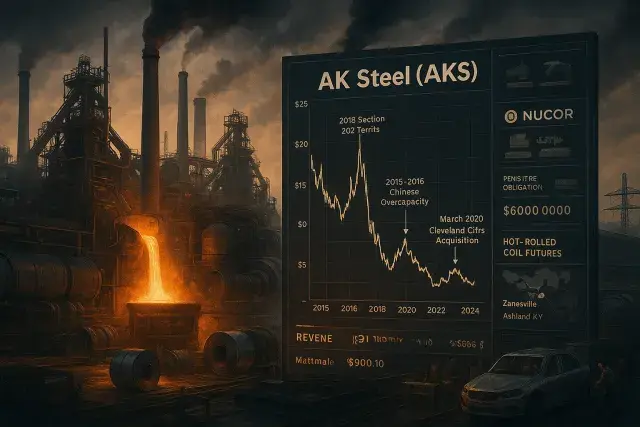
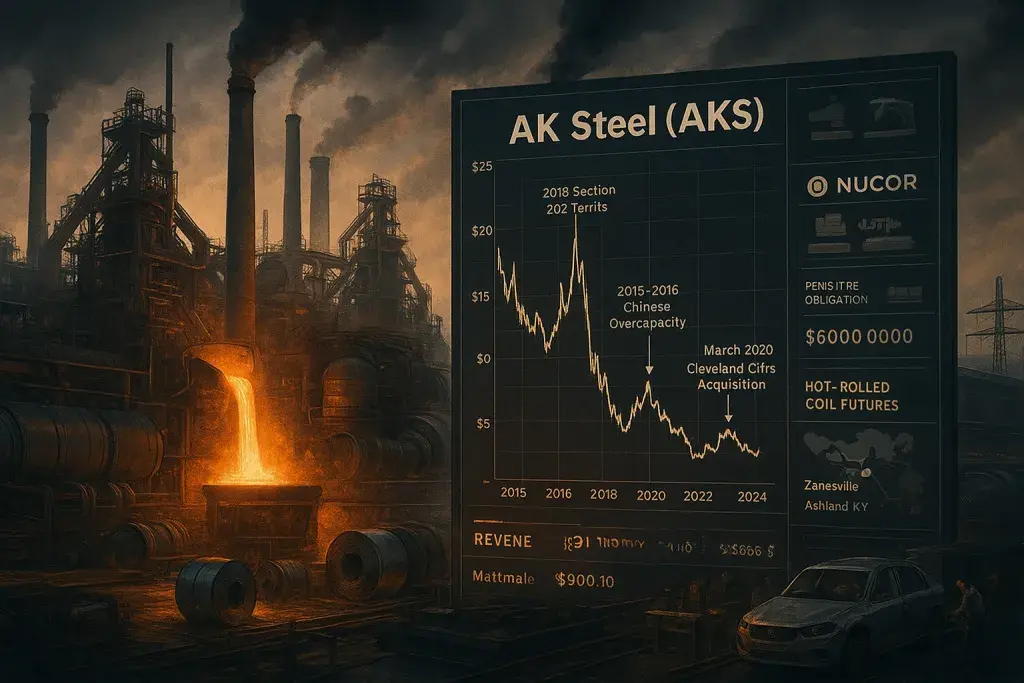
The 2015-2016 period marked another significant stress point. Global steel overcapacity - driven primarily by Chinese steel exports flooding international markets - compressed domestic steel prices, and AKS stock price fell sharply again, reflecting both sector-wide weakness and company-specific leverage concerns. The stock dropped below three dollars per share at its 2016 trough, raising legitimate questions about the company's financial stability.
The trade tariff environment of 2018 provided a meaningful catalyst for recovery. Section 232 tariffs on imported steel raised domestic prices, improved margins for U.S. producers including AK Steel, and drove a significant rally in AKS stock price. By mid-2018, the stock had more than doubled from its 2016 lows. That rally, however, proved difficult to sustain as raw material costs rose alongside steel prices, limiting the margin benefit, and as global trade uncertainty dampened investor confidence.
The stock spent its final trading years in a relatively compressed range before the Cleveland-Cliffs acquisition in early 2020 set a transaction price that effectively ended independent AKS price discovery.
Short-Term Volatility Patterns and Catalysts
On a quarter-to-quarter basis, AKS stock price was highly sensitive to a specific set of recurring catalysts. Earnings announcements were the most predictable source of short-term volatility: when the company reported stronger-than-expected margins - typically driven by favorable steel price realizations or better cost management - the stock responded positively. When raw material cost increases outpaced realized steel prices, results disappointed and the stock sold off quickly.
Trade policy announcements created some of the sharpest single-day moves in AKS price history. The initial announcement of Section 232 steel tariffs in early 2018 triggered an immediate rally across domestic steel stocks, with AKS among the largest beneficiaries. Conversely, news of tariff exemptions granted to specific trading partners or signs of softening trade enforcement typically pressured the stock.
Automotive production data also served as a leading indicator. Monthly U.S. vehicle sales figures and production schedules from major automakers gave investors an early read on the demand environment for AK Steel's highest-margin products. A shift toward truck and SUV production - vehicles that use more steel per unit than passenger cars - was historically positive for AKS volume and mix.
AK Steel Market Trends Within the Broader Steel Sector
When viewed against sector peers, AKS displayed several distinctive characteristics. Its integrated production model meant it was more exposed to input cost swings than electric arc furnace producers like Nucor or Steel Dynamics, which use scrap metal as their primary raw material and benefit from scrap price declines during economic downturns. This structural difference consistently showed up in comparative margin performance across market cycles.
| Company / Ticker | Primary Production Method | Main Steel Segment | Cost Structure Profile | Status (as of 2020) |
|---|---|---|---|---|
| AK Steel (AKS) | Integrated blast furnace | Specialty flat-rolled, automotive | High fixed costs, pension obligations | Acquired by Cleveland-Cliffs |
| Nucor (NUE) | Electric arc furnace (mini-mill) | Structural, sheet, bar products | Lower fixed costs, flexible capacity | Independent, publicly traded |
| U.S. Steel (X) | Integrated blast furnace | Flat-rolled, tubular products | High fixed costs, significant leverage | Independent, publicly traded |
| Steel Dynamics (STLD) | Electric arc furnace (mini-mill) | Sheet, long products, fabrication | Lower fixed costs, high margins | Independent, publicly traded |
AK Steel market trends often tracked sector-wide steel pricing cycles closely but with additional amplification from its debt load. When the cycle turned negative, AKS tended to underperform lower-leverage peers. When trade protection created domestic pricing tailwinds, AKS could outperform because the tariff benefit applied directly to the domestic pricing environment it operated in - without the natural hedge of scrap-cost flexibility that mini-mills enjoyed.
Deep Dive into AKS Financial Reports
Reading AKS financial reports required an understanding that this was a company where headline revenue figures told only part of the story. The interaction between steel price realizations, raw material costs, pension expense, and debt service created a financial profile that looked very different at the top line than it did at the net income level.
Revenue Trends and Segment Performance
AK Steel generated several billion dollars in annual revenue across most of its final trading years, with the exact figure fluctuating significantly based on steel pricing environments rather than volume changes alone. The company's shipment volumes were relatively stable - driven by long-term automotive contracts - but realized prices per ton moved considerably with market conditions. This meant that revenue could swing substantially year over year even when physical steel volumes shipped remained roughly constant.
Carbon steel products represented the largest portion of revenue, reflecting the company's dominant position in automotive flat-rolled supply. Stainless steel contributed a meaningful but smaller share, while electrical steel - used in power transformers and electric motors - represented a niche but strategically important product line with favorable margin characteristics.
- Carbon steel: the largest revenue segment, driven by automotive supply contracts
- Stainless steel: a smaller but margin-enhancing product category with distinct pricing dynamics
- Electrical steel: specialized grain-oriented products for transformer and motor applications
- Revenue sensitivity: annual figures moved substantially with hot-rolled coil benchmark prices even at stable shipment volumes
- Automotive exposure: vehicle production schedules at major U.S. manufacturers directly influenced quarterly results
Profitability, Margins, and Earnings Analysis
AK Steel's profitability record was uneven - a characteristic common to integrated steel producers but more pronounced at AKS given its cost structure. Gross margins expanded meaningfully during periods of strong steel pricing, particularly in 2018 when tariff-supported domestic prices created favorable spreads over input costs. During those periods, the company demonstrated genuine earnings power at the operating level.
The challenge appeared further down the income statement. Pension and OPEB (other post-employment benefit) expenses created a recurring charge that reduced reported net income significantly. These obligations reflected decades of commitments made to a unionized workforce - they were real cash and non-cash costs that could not be quickly restructured. Investors who looked only at operating income without adjusting for these legacy costs risked overestimating AK Steel's true earnings capacity relative to peers who carried no comparable obligations.
During unfavorable periods - particularly 2015 and 2016 - AKS reported net losses as steel price declines compressed margins faster than the company could reduce costs. The integrated production model, with its high fixed cost base, offered limited flexibility to scale back operations quickly when demand softened, unlike mini-mill producers that could reduce output more readily by adjusting furnace utilization.
EBITDA margins for AKS generally ran below those of best-in-class mini-mill operators during comparable periods, reflecting both the cost structure differences and the pension expense drag. This margin gap was a consistent feature of comparative AKS market analysis across multiple reporting cycles.
Balance Sheet Strength and Debt Management
Debt was the defining feature of AK Steel's balance sheet throughout most of its history as a public company. The company carried several billion dollars in total debt obligations, a figure that remained elevated relative to its earnings capacity and created meaningful financial risk during downturns in the steel cycle.
High leverage in a cyclical industry creates a specific and serious problem: when revenues decline - as they inevitably do during steel price downturns - fixed debt service costs remain constant, consuming an increasing share of operating cash flow. For AKS, this dynamic contributed to the stock's amplified downside performance relative to less-leveraged peers during sector downturns. The 2015-2016 period made this risk visible in market pricing, with credit concerns supplementing the operational pressure from weak steel prices.
Management made periodic efforts to address the debt load through refinancing transactions that extended maturities and reduced near-term liquidity risk. These actions improved the company's financial stability without eliminating the fundamental leverage problem. Pension obligations added another layer of complexity, representing long-duration liabilities whose present value was sensitive to changes in discount rates and actuarial assumptions.
Warning: Investors evaluating cyclical industrial stocks with high debt loads must distinguish between short-term liquidity risk and longer-term solvency risk. AKS demonstrated that a company can maintain adequate near-term liquidity while still carrying a balance sheet that limits equity upside and amplifies downside during adverse cycle phases.
Cash Flow Analysis and Capital Allocation
Operating cash flow at AKS was highly cyclical, tracking the steel pricing environment closely. During favorable pricing periods, the company generated meaningful operating cash flow that supported both capital maintenance spending and modest debt reduction. During downturns, operating cash flow contracted sharply, limiting financial flexibility.
Capital expenditures at an integrated steel producer are substantial and largely non-discretionary. Blast furnaces, casters, and rolling mills require ongoing maintenance investment to remain operational, regardless of the market environment. This meant that free cash flow - operating cash flow after capital expenditures - was often thin even during moderately favorable periods, leaving limited room for aggressive debt repayment or shareholder returns.
Dividend payments were suspended at points during the company's history when cash preservation became necessary, a pattern that illustrates why income-focused investors need to scrutinize free cash flow sustainability rather than relying on dividend yield alone when evaluating cyclical industrial stocks. Capital allocation decisions at AKS consistently reflected the tension between investment for operational competitiveness and debt management - a tension the Cleveland-Cliffs acquisition ultimately resolved through consolidation.
AKS Market Analysis: Competitive Position and Industry Dynamics
No stock analysis is complete without understanding the competitive environment a company operates within. For AKS, the external forces shaping market position were as important as internal financial management - and the AKS market analysis framework must account for both domestic competition and global industry dynamics.
Competitive Landscape and Market Share
AK Steel's competitive strengths were genuine but narrow. The company's expertise in advanced high-strength steel for automotive applications gave it defensible positions with customers who valued quality consistency and technical support over price alone. Automotive manufacturers designing lightweight vehicle structures required steel grades with precise mechanical properties - and switching suppliers for those applications carried engineering and qualification costs that created customer stickiness.
The company's weaknesses were equally real. Its integrated production cost structure meant it could not compete on pure price against mini-mill producers in commodity steel grades. When automotive customers pushed for cost reductions, AKS had less margin flexibility than lower-cost competitors. Its geographic concentration in the Midwest, while strategically logical given the location of automotive assembly plants, left it with limited diversification across end markets or geographies.
| Competitive Dimension | AK Steel (AKS) | Nucor (NUE) | Steel Dynamics (STLD) |
|---|---|---|---|
| Specialty automotive steel capability | Strong - core competency | Growing, but historically smaller share | Growing through investment |
| Cost structure flexibility | Limited - high fixed costs | High - mini-mill model | High - mini-mill model |
| Leverage and balance sheet | High debt, pension obligations | Conservative, investment-grade | Moderate, well-managed |
| Geographic diversification | Concentrated in Midwest | Broad national footprint | Broad national footprint |
| Dividend consistency | Inconsistent, suspended at times | Consistent, long dividend history | Consistent, growing dividend |
Macro Drivers: Trade Policy, Infrastructure Spending, and Global Demand
Few external forces shaped AK Steel market trends more decisively than trade policy. The Section 232 tariffs imposed in 2018 under the Trade Expansion Act created a significant pricing umbrella for domestic steel producers by raising the cost of imported steel. For AKS, which sold exclusively into the domestic market, the tariffs translated directly into improved price realizations on carbon steel products. The stock's rally in the first half of 2018 reflected this benefit.
The mechanism was straightforward: domestic steel prices, particularly for hot-rolled coil, rose toward import-parity levels plus tariff. Domestic producers captured this premium. However, the benefit was partially offset as raw material costs - particularly scrap metal and iron ore - also rose in a stronger demand environment, compressing the gross margin improvement below what the headline price increase suggested.
Infrastructure spending cycles matter for steel demand broadly, though AK Steel's automotive focus meant its sensitivity to construction-driven demand was lower than that of structural steel producers. Nevertheless, periods of strong infrastructure investment in the U.S. historically supported tighter overall steel market conditions, reducing imports and supporting pricing across grades.
Global steel overcapacity - particularly from Chinese producers - remained a persistent structural threat. Chinese steel capacity expanded dramatically in the 2000s and 2010s, and when domestic Chinese demand faltered, excess production flowed into export markets, depressing international prices. While tariffs provided domestic insulation, the underlying global oversupply dynamic created a ceiling on how far domestic prices could rise before import arbitrage reasserted itself.
Raw Material Cost Pressures and Supply Chain Vulnerabilities
AK Steel's integrated production model required large and continuous inputs of iron ore, metallurgical coal, and energy. Each of these inputs had its own pricing cycle, and the interaction between input costs and steel price realizations drove margin performance more than any other single factor.
Iron ore prices fluctuate with global steel production levels, particularly Chinese blast furnace utilization rates. When Chinese steel output ran high, iron ore demand was strong and prices rose - increasing costs for integrated producers like AKS. Metallurgical coal, used in blast furnace steelmaking, showed similarly volatile price behavior, with supply disruptions - including weather-related events at Australian mining operations - capable of causing sharp short-term cost spikes.
Energy costs represented another meaningful input category, particularly for facilities running continuous casting and rolling operations. Natural gas and electricity prices in the Midwest affected per-ton production costs, though AK Steel had some hedging capacity through procurement contracts. The key vulnerability was the lag between rising input costs and the ability to pass those increases through to customers on fixed-contract pricing arrangements, which were common in automotive supply relationships.
AKS Investment Opportunities: Risk-Return Assessment
Any honest evaluation of AKS investment opportunities required holding two realities simultaneously: the company had genuine strategic assets and operated in a sector with periodic cycles of strong profitability, but it also carried structural vulnerabilities that limited equity upside and amplified downside risk in ways that were not always obvious from surface-level analysis.
Bull Case: Reasons to Consider AKS Investment Opportunities
The strongest arguments for AKS centered on its specialty positioning, sector cyclicality, and the potential for tariff-supported margin recovery. Investors who understood the steel cycle well enough to identify trough conditions - when AKS stock price reflected maximum pessimism about steel pricing and company-specific leverage fears - could acquire exposure to a meaningful recovery at depressed valuations.
The automotive sector's long-term trajectory offered specific tailwinds for AK Steel's product mix. The transition toward electric vehicles required grain-oriented electrical steel for motor components and lighter, stronger steel grades for battery enclosures and structural applications - product categories where AK Steel had established manufacturing capabilities. This created a case that AKS was not simply a commodity steel play but a positioned participant in the structural shift toward next-generation vehicle production.
- Specialty automotive steel expertise defensible against generic commodity competitors
- Electric vehicle transition creating incremental demand for electrical steel and advanced high-strength grades
- Section 232 trade protections providing domestic pricing support for U.S. producers
- Cyclical trough valuations periodically offering deeply discounted entry points relative to normalized earnings
- Cleveland-Cliffs acquisition ultimately delivering a transaction premium to AKS shareholders
Bear Case: Risks and Challenges for AKS Investors
The risks attached to AKS were substantial and required clear-eyed acknowledgment. The combination of high financial leverage with cyclical revenue exposure created a fundamentally fragile financial structure - one that worked well during up-cycles but was genuinely vulnerable during downturns. The 2015-2016 period, when AKS stock price fell into single digits and credit concerns became part of the investment conversation, illustrated exactly what that fragility looked like in practice.
Pension and legacy benefit obligations represented a category of liability that did not appear prominently in market headlines but weighed consistently on cash flow and balance sheet health. These obligations could not be renegotiated quickly and created a persistent drag on financial performance across all cycle phases.
- High financial leverage amplifying equity losses during steel price downturns
- Pension and OPEB obligations creating significant non-operational cash demands
- Integrated production model limiting cost flexibility relative to mini-mill competitors
- Persistent global steel oversupply creating a structural ceiling on domestic pricing
- Automotive sector production disruptions - whether from economic cycles or supply chain events - flowing directly into AKS revenue
Valuation Framework: How to Assess AKS Investment Value
Standard price-to-earnings ratios are poorly suited to cyclical industrial stocks like AKS. Earnings fluctuate so dramatically across the cycle that a P/E ratio calculated at a trough understates cheapness while one calculated at a peak overstates it. Professional investors in the steel sector consistently applied mid-cycle normalized metrics instead.
The most widely used approach involved EV/EBITDA calculated on normalized - or mid-cycle - EBITDA rather than trailing reported figures. This required estimating what AKS could earn at a mid-point steel price environment, adjusting for a realistic cost structure, and then applying a sector-appropriate multiple to derive an implied enterprise value. Subtracting net debt from that enterprise value produced an implied equity value per share that could be compared to the current AKS stock price.
- Identify the current phase of the steel pricing cycle relative to historical averages
- Estimate normalized EBITDA using a mid-cycle hot-rolled coil price assumption rather than spot prices
- Apply a sector-appropriate EV/EBITDA multiple, adjusted downward for AKS's higher-than-average leverage and pension risk
- Calculate implied enterprise value from the normalized EBITDA and chosen multiple
- Subtract total net debt and pension obligations to arrive at implied equity value
- Compare implied per-share value to current AKS stock price to assess whether a margin of safety exists
This framework will not produce a precise answer - steel cycle timing is inherently uncertain - but it provides a disciplined structure for avoiding the most common valuation mistakes, particularly buying at cycle peaks when reported earnings are temporarily elevated and appear to justify high prices that subsequent downturns will reveal as unsustainable.
Post-Acquisition Context: AK Steel Under Cleveland-Cliffs
The Cleveland-Cliffs acquisition of AK Steel in March 2020 was not a distressed sale - it was a strategic transaction with a clear industrial logic. Cleveland-Cliffs, historically a supplier of iron ore pellets to blast furnace steelmakers including AK Steel, made the decision to move downstream into finished steel production. Acquiring AK Steel gave it control of the manufacturing facilities that consumed its ore, creating a vertically integrated producer that could capture value at multiple points in the supply chain.
The transaction was structured as a stock-and-debt deal in which AKS shareholders received Cleveland-Cliffs shares at an exchange ratio that implied a modest premium to AKS's recent trading price. The acquisition closed as the COVID-19 pandemic was beginning to disrupt global markets, making the immediate post-close environment particularly challenging for both parties.
For former AKS shareholders who received CLF shares, the investment thesis shifted from a pure specialty steel producer play to a vertically integrated iron ore and steel company with a larger operational footprint. Cleveland-Cliffs subsequently acquired U.S. Steel's former operations and other assets, expanding further - meaning that tracking the legacy AK Steel business required examining Cleveland-Cliffs segment disclosures rather than standalone filings.
- Transaction structure: AKS shareholders received Cleveland-Cliffs shares at a negotiated exchange ratio
- Strategic rationale: vertical integration from iron ore production through finished automotive steel
- Operational continuity: AK Steel's facilities continued operating under Cleveland-Cliffs ownership
- Tracking legacy performance: requires reviewing CLF quarterly segment disclosures rather than standalone AKS filings
- Investment implication: former AKS holders gained exposure to a larger, more diversified integrated steel platform
The acquisition effectively resolved the tension that had defined AKS as a standalone investment - the gap between operational capability and balance sheet constraint. Within a larger combined entity, the leverage dynamics changed, and the long-term strategic positioning improved. Whether that outcome delivered adequate value to AKS shareholders depended substantially on the exchange ratio and the subsequent performance of Cleveland-Cliffs equity.
Practical Investment Guidance: Applying AKS Insights to Portfolio Strategy
The AKS story contains lessons that extend well beyond this single company. Investors who understand how AK Steel's stock behaved across different market environments are better positioned to evaluate any cyclical industrial equity - including Cleveland-Cliffs today and other integrated steel producers in domestic and international markets.
Portfolio Positioning in Cyclical Industrial Stocks
Cyclical stocks reward investors who enter near cycle troughs and penalize those who buy at peaks. This sounds simple but is consistently difficult to execute because trough conditions are accompanied by negative headlines, credit concerns, and genuine uncertainty about recovery timing - exactly the environment that discourages buying. Recognizing that environment as a potential entry point rather than a reason to exit requires both analytical conviction and genuine risk tolerance.
Position sizing matters considerably for cyclical names. Because the downside in a cyclical industrial stock at the wrong phase of the cycle can be severe - AKS demonstrated losses of fifty percent or more during sector downturns - allocating a modest position relative to total portfolio value limits damage if cycle timing proves incorrect. Conversely, that same volatility creates meaningful upside for appropriately sized positions entered near trough conditions.
Stop-loss disciplines can be useful for cyclical positions, though they must be calibrated carefully. Setting stops based on percentage price declines from entry protects against catastrophic losses but may also trigger exits during short-term volatility that precedes a recovery. Many experienced industrial investors prefer a combination of position size limits and fundamental triggers - such as a specified deterioration in the steel pricing environment - rather than mechanical price-based stop rules.
Monitoring the Right Signals: What to Track After AKS
Investors who built expertise following AKS developed instincts about which indicators to watch ahead of price-moving events. Those skills remain directly applicable to Cleveland-Cliffs and other steel sector investments.
- Hot-rolled coil (HRC) futures prices: the most direct leading indicator of domestic flat-rolled steel margin potential
- U.S. ISM Manufacturing PMI: a monthly gauge of industrial demand momentum that historically correlates with steel order patterns
- Monthly U.S. auto sales and production schedules: direct demand signal for automotive-grade flat-rolled steel
- Infrastructure spending legislative and appropriations developments: affect structural steel demand and broader industry conditions
- Cleveland-Cliffs quarterly earnings: the primary vehicle for tracking AK Steel legacy operations post-acquisition
- Chinese steel export data: a gauge of global overcapacity pressure on international and domestic pricing
Common Mistakes Investors Make With Steel Stocks
AKS provided a repeated case study in the errors retail investors make with cyclical industrials. The most damaging pattern was buying after a strong price move - often triggered by tariff announcements or a favorable earnings surprise - without recognizing that the catalyst had already been priced in and that the underlying steel cycle might be approaching a peak rather than a trough.
A second persistent mistake involved comparing AKS on traditional P/E ratios to other industrial stocks without adjusting for the cyclicality of the earnings base. A low P/E ratio during a steel price boom looked attractive but often reflected peak earnings that were unlikely to be sustained through the following cycle trough. Investors who anchored to those peak earnings frequently overpaid.
- Buying momentum after tariff-driven rallies without assessing where the stock sits in the cycle
- Using trailing P/E ratios for valuation without normalizing for mid-cycle earnings
- Ignoring total debt, pension obligations, and their effect on equity value when comparing AKS to cleaner-balance-sheet peers
- Treating short-term margin improvements as permanent structural upgrades rather than cyclical effects
- Failing to monitor leading indicators between earnings announcements, missing early signals of deteriorating conditions
Each of these mistakes was avoidable with a systematic analytical framework. The AKS investment history makes the consequences concrete - and that concrete example is precisely what makes studying this stock useful even after it ceased to trade independently.
Questions and Answers
Why did AKS stock price tend to underperform steel sector peers during downturns even when its revenues declined by similar amounts?
AKS carried significantly higher financial leverage than mini-mill competitors like Nucor and Steel Dynamics. When revenues declined, fixed debt service costs and pension obligations consumed a disproportionate share of operating cash flow, leaving equity holders with reduced residual value. Higher leverage amplifies both upside and downside in cyclical industries, and during prolonged downturns the equity cushion erodes faster than at lower-leverage peers.
How can investors access historical AKS financial reports now that the company no longer files independently?
Historical AK Steel SEC filings - including annual 10-K reports and quarterly 10-Q filings - remain accessible through the SEC EDGAR database using the company name or its CIK number. For performance after the March 2020 acquisition, investors should review Cleveland-Cliffs quarterly and annual filings, which contain segment-level disclosures that reflect AK Steel's legacy operations within the combined entity.
What distinguished AK Steel's electrical steel products from its other revenue segments, and why did that distinction matter for investors?
Grain-oriented electrical steel is a specialized product used in power transformers and electric motors, manufactured through a technically demanding process that few producers globally can match. This product commanded higher margins than commodity carbon steel and served customers with fewer alternative suppliers, creating a more defensible pricing position. For investors, the electrical steel segment represented the highest-quality revenue within AKS's portfolio - stable, margin-rich, and strategically relevant to long-term electrification trends.
Was the Cleveland-Cliffs acquisition at a fair price for AKS shareholders?
The transaction closed in early March 2020, weeks before the full impact of COVID-19 on equity markets became apparent, and the exchange ratio implied a modest premium to AKS's recent trading price. Whether the price was fair depends significantly on the time horizon used for evaluation: shareholders who held the resulting CLF shares through the subsequent steel market recovery benefited meaningfully from the combined entity's performance, while those who sold CLF shares immediately in the volatile early-pandemic environment may have received less than the transaction's long-term value implied.
What is the most reliable valuation metric for comparing steel stocks across different cycle phases?
EV/EBITDA calculated on normalized mid-cycle earnings is the most widely used and analytically sound approach for steel sector valuation. It removes the distortion created by interest expense differences, depreciation policy variations, and tax timing effects - and when applied to a normalized rather than trailing EBITDA, it also removes the most significant source of cyclical mispricing. Price-to-book value serves as a useful secondary check, particularly for assessing asset replacement value during trough periods.
How should an investor today think about AKS-related investment exposure given that the stock no longer trades?
Cleveland-Cliffs (ticker: CLF) is the direct successor to AKS's operational and financial legacy. Investors seeking exposure to the AK Steel business model - integrated specialty flat-rolled steel for automotive and industrial applications - should evaluate CLF as the primary vehicle, supplemented by monitoring of hot-rolled coil prices, automotive production data, and the same macroeconomic indicators that historically drove AKS stock price performance. The analytical framework developed for AKS translates directly to evaluating the combined entity.