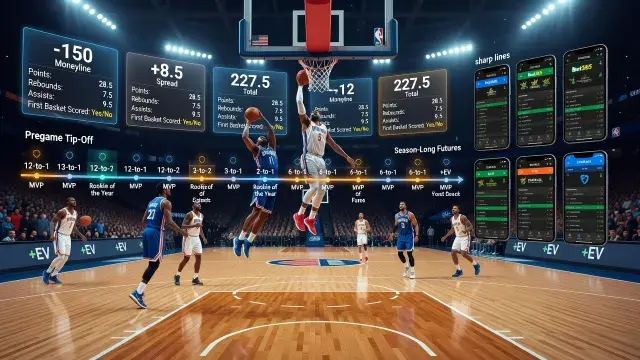
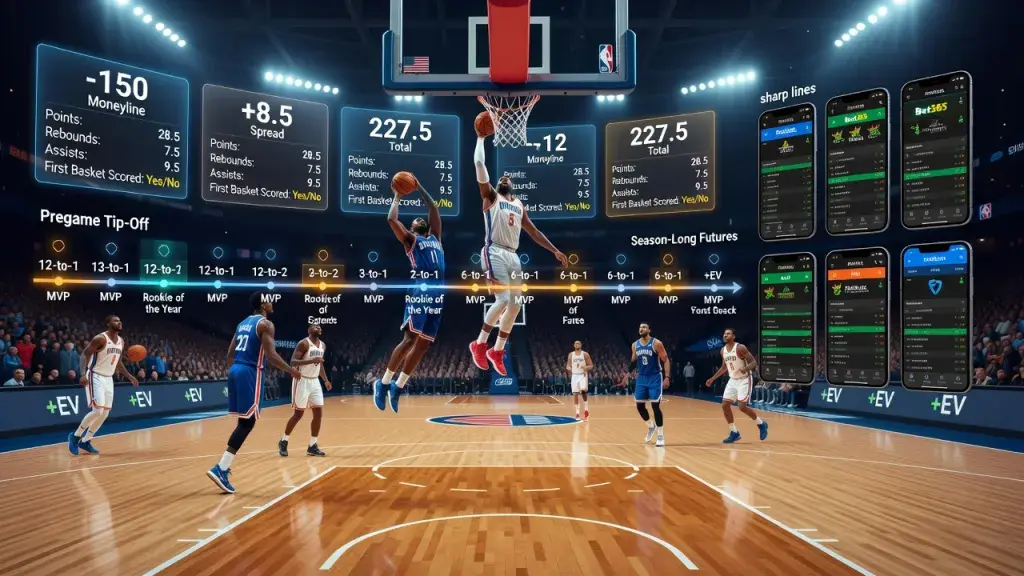
A three-point line drawn 23 feet from the basket has quietly reshaped how sportsbooks price an entire sport. Every possession now carries more variance than it did a decade ago, and that variance is exactly what basketball odds attempt to measure, moment by moment, game by game, season by season. Understanding how those numbers move - and why - separates bettors who make informed decisions from those who are simply guessing with better vocabulary.
This matters because basketball offers more betting formats than almost any other major sport. You can wager on a game before it tips off, adjust your position while it's being played, bet on an individual player's rebound total, or lock in a prediction on which team wins the championship five months before the playoffs start. Each format prices risk differently, and each rewards a different kind of preparation. Before placing real money on any of these markets, it helps to compare how various basketball betting sites structure their lines, since even small differences in odds compound significantly over a full season of wagering. Choosing where you bet is not a minor detail - it's part of the strategy.
What follows is a practical breakdown of how basketball odds work across the formats that matter most: pregame markets, live betting, player props, and futures. Along the way, we'll look at how to read line movement, when to trust a favorite, and which platforms tend to offer the sharpest numbers.
Understanding Basketball Odds: The Foundation
Before betting live, on props, or on futures, you need fluency in how basketball odds are quoted and what they actually represent. Odds are not a prediction of certainty - they're a reflection of implied probability, adjusted for the bookmaker's margin. A team listed at -150 isn't guaranteed to win; the number simply tells you how the market has priced that outcome relative to the payout.
Moneyline, Spread, and Total: The Three Core Markets
Basketball betting revolves around three foundational bet types. The moneyline asks a simple question: who wins the game outright? The point spread levels the playing field by adding or subtracting points from the final score, which is why a heavy favorite might be priced at -8.5 rather than a lopsided moneyline number. The total, or over/under, asks whether the combined score of both teams will exceed or fall short of a set number. Each market reacts differently to the same piece of news - an injury to a starting center, for instance, might barely move the moneyline but shift the total by three or four points because of how it affects pace.
How Odds Format Affects Reading the Market
American odds (-110, +250), decimal odds (1.91, 3.50), and fractional odds (10/11, 5/2) all express the same underlying probability in different notation. Most U.S.-facing sportsbooks default to American odds, but the ability to convert between formats quickly helps when comparing lines across different basketball betting sites, some of which cater more heavily to European or Asian bettors and default to decimal pricing.
Why Odds Move Between Open and Tip-Off
A line posted on Monday for a Saturday game rarely survives untouched. Injury reports, lineup changes, and the direction of public betting all push numbers around. Sharp bettors track this movement closely because a line that moves against the majority of public bets often signals that professional money is on the other side - a phenomenon oddsmakers actively try to balance against.
- Moneyline: straightforward win/loss bet, no point adjustment
- Spread: margin-adjusted bet designed to balance action on both sides
- Total: bet on combined scoring output, independent of who wins
Mastering Live Basketball Betting
Live basketball betting has grown into one of the most active segments of the industry because basketball's pace creates constant pricing opportunities. Unlike football, where long stretches pass without scoring, basketball produces a new data point roughly every 24 seconds. That rhythm makes in-game odds unusually responsive - and unusually exploitable for bettors who know what they're watching for.
How In-Game Lines Are Calculated in Real Time
Live odds are generated algorithmically, updating win probability based on score, time remaining, pace, foul trouble, and possession. A ten-point deficit with eight minutes left in the fourth quarter carries a very different probability than the same deficit with two minutes remaining, and the odds reflect that shift almost instantly.
Reading Momentum Without Overreacting to It
Sportsbooks price in short-term momentum, sometimes too aggressively. A 10-0 run can inflate a live line beyond what the underlying talent gap justifies, creating value for bettors willing to bet against the crowd's emotional read of the game. Recognizing when a line has overcorrected is a skill built through repetition, not instinct alone.
Timing Your Bet: First Half, Second Half, and Quarter Lines
Live basketball betting isn't limited to full-game outcomes. Bettors can wager on second-half spreads, individual quarters, or even the next team to score. These micro-markets require sharper attention but often carry softer pricing than the more heavily bet full-game lines, since fewer bettors dedicate time to them.
Basketball Prop Bets: Beyond the Final Score
Prop betting shifts the focus from the scoreboard to individual performance, and basketball happens to be exceptionally well-suited to this format because so much of the sport is quantified - points, rebounds, assists, three-pointers made, even the first player to score.
Player Performance Props Explained
The most common prop format sets a statistical line - say, 27.5 points for a star scorer - and asks whether the player will go over or under that number. These lines are built from recent performance trends, matchup data, and pace projections, and they can shift sharply based on late-breaking news like a minutes restriction or a tough defensive matchup.
Game and Team Props
Not all basketball prop bets center on individuals. Team-based props - first team to reach 20 points, largest lead of the game, total three-pointers made by both teams combined - offer additional angles for bettors who want exposure to a game without picking a straight winner.
Why Props Require Different Research Than Spreads
Spread betting rewards macro-level analysis: team strength, schedule spots, injuries. Prop betting rewards granular research - usage rate, minutes trends, positional matchups, and even referee tendencies that affect foul calls and free-throw opportunities. Treating props with the same broad strokes used for spread betting is a common and costly mistake.
- Points, rebounds, and assists props for individual players
- Combination props such as points plus rebounds plus assists
- First basket scored and player to foul out
- Team-based totals like first-quarter points or total threes made
NBA Futures Betting: Playing the Long Game
NBA futures betting operates on an entirely different timescale than live or prop wagering. Instead of reacting to a single game, futures bets ask you to project outcomes across an entire season - championship winner, conference winner, division winner, or individual award races like MVP and Rookie of the Year.
Championship and Conference Futures
Championship odds are posted before the season starts and fluctuate constantly based on injuries, trades, and in-season performance. A team priced at 12-to-1 in October might drop to 6-to-1 by January after a strong start, meaning early bettors who correctly identify undervalued teams can lock in significantly better returns than those who wait.
Award Futures: MVP, Rookie of the Year, and More
Individual award markets reward bettors who track usage trends and team success closely, since award voting tends to favor players on winning teams. MVP odds in particular shift heavily based on narrative momentum, which creates opportunities for value early in the season before storylines solidify.
Timing Your Futures Bets for Maximum Value
The core tension in NBA futures betting is simple: betting early offers better odds but less certainty, while betting later offers more information but worse pricing. A disciplined approach often means splitting futures bets across multiple points in the season rather than committing everything before a single tip-off.
Choosing the Best Basketball Betting Sites
Not all sportsbooks price basketball markets the same way, and the differences go beyond marketing. Line accuracy, market depth, and payout speed vary enough between platforms that comparing them directly can meaningfully affect long-term profitability.
What Separates Top-Tier Sportsbooks
The strongest basketball betting sites offer deep markets across live betting, props, and futures simultaneously, rather than excelling in one category while neglecting others. Depth matters because a bettor who wants to shop for the best number on a prop bet needs multiple live, competitive markets to compare.
Bonuses, Limits, and Line Shopping
Sign-up promotions attract attention, but recurring value comes from bet limits and consistent pricing. A site offering generous limits on player props, for example, is more useful to a serious prop bettor than one offering a large but one-time deposit bonus.
Mobile Experience and Live Betting Speed
Live basketball betting depends on speed. A sportsbook with a slow app or delayed odds refresh can cost bettors real opportunities during fast-moving stretches of a game, making mobile performance a practical factor rather than a cosmetic one.
Building a Smarter Basketball Betting Strategy
Individual bets matter less than the framework around them. A coherent strategy connects pregame research, live adjustments, and long-term futures positioning into a single approach rather than treating each bet in isolation.
Bankroll Management Across Bet Types
Futures bets tie up money for months, live bets require capital available in real time, and props demand frequent, smaller stakes. Allocating bankroll across these categories in advance prevents the common mistake of overcommitting to one format and having nothing left for the others.
Using Data Instead of Instinct
Pace, defensive efficiency, and rest days consistently outperform gut feeling as predictors of outcome. Bettors who build decisions around measurable trends tend to outperform those relying on team loyalty or recency bias from a single highlight-reel performance.
Avoiding the Most Common Betting Mistakes
Chasing losses after a bad beat, ignoring injury reports, and betting too many props in a single game without staggering risk are among the most frequent errors. Each is avoidable with a set of pre-defined rules established before the season, not during an emotional stretch of losses.
Questions?
What's the difference between basketball odds and betting lines? Odds refer to the payout structure and implied probability of an outcome, while a line typically refers to the specific number set for a spread or total. The terms overlap in casual use but describe different pieces of the same market.
Is live basketball betting riskier than pregame betting?
It carries different risk, not necessarily more. Live betting demands faster decisions and real-time analysis, but it also offers the chance to react to information - like foul trouble or a cold shooting stretch - that wasn't available before tip-off.
How early should I place NBA futures bets for the best value?
The best value typically appears before the season starts or very early in it, when public perception hasn't caught up to a team's actual quality. Waiting until after a strong winning streak usually means accepting shorter odds on the same outcome.
Are basketball prop bets harder to win than spread bets?
They require different research, not necessarily more difficulty. Prop bets hinge on individual performance variables like minutes and usage rate, which can be more predictable in some cases than a full team's performance against the spread.
Why do basketball odds move so much right before tip-off?
Late lineup news, star player rest decisions, and last-minute sharp betting action all concentrate in the final hours before a game. Sportsbooks adjust quickly to avoid being exposed on one side of a line once new information arrives.
Should I use multiple betting sites instead of just one?
Using more than one platform allows you to compare pricing on the same game and often secure better odds on spreads, props, or futures. The small differences in pricing between sites add up meaningfully over a full season of consistent betting.