Fifty percent. That is the theoretical odds of a coin landing on either side, and yet no two flips ever feel the same. A physicist can model the trajectory, the spin rate, and the air resistance acting on a coin mid-flight, but the moment it lands on a table or a palm, prediction gives way to pure outcome. That gap between mathematical certainty and lived experience is exactly why the coin toss challenge has endured for centuries as a way to settle disputes, start matches, and now, entertain millions online.
What began as a practical tool for decision-making has evolved into something far more entertaining. Digital platforms have transformed this basic act of chance into a fully interactive experience, complete with visual effects, streaks, and stakes. Anyone curious about how far this concept has been pushed can explore a crazy coin flip game that takes the simple binary outcome and wraps it in layers of suspense and reward. The appeal isn't complicated - it's the same reason people have flipped coins since ancient Rome, just amplified by modern design.
This piece breaks down why the coin toss remains one of the most trusted and most misunderstood random chance game formats in existence, how the heads or tails game translates into digital entertainment, and what separates a fair mechanism from a rigged one.
The Origins and Logic of the Coin Toss
Long before dice, cards, or algorithms, there was the coin. Its appeal rests on a simple structural fact: a coin has exactly two flat, roughly equal faces, making it a natural tool for binary decisions. Ancient societies used similar objects - shells, stones, marked sticks - for the same purpose, but coins offered symmetry, portability, and a satisfying physical action that felt fair to both parties involved.
Why Two Sides Create Perceived Fairness
The psychological weight of a coin toss comes from its apparent neutrality. Neither party controls the outcome once the coin leaves the thumb. This is different from drawing straws or guessing a number, where subtle manipulation feels more plausible. A flipped coin, spinning fast enough, erases any sense of human influence, which is precisely why referees, judges, and even software engineers designing random number generators still reference the coin flip as the gold standard of impartiality.
From Ceremony to Sport to Screen
Coin tosses have opened football matches, decided tied elections in small jurisdictions, and even settled property disputes in earlier centuries. Sports still use the ritual today - a referee's coin toss determines which team kicks off or which end they defend. That same ritualistic tension has been carried into gaming platforms, where the ceremony of the flip is preserved even though the mechanism behind it is now digital rather than metallic.
How the Heads or Tails Game Works in Digital Form
Translating a physical coin flip into software requires more than showing an image spinning on a screen. Developers rely on random number generation to simulate the unpredictability of a real coin, ensuring that neither heads nor tails is favored across thousands of iterations.
Random Number Generation as the Digital Coin
Behind every digital heads or tails game sits a random number generator, typically seeded with unpredictable inputs like system time or hardware noise. The generator produces a value that maps directly to one of two outcomes, mimicking the physical randomness of an actual coin without any bias toward either result. Reputable platforms subject these generators to independent testing to confirm the distribution stays close to fifty-fifty over large sample sizes.
Visual and Audio Design That Builds Tension
A digital coin doesn't need to spin for three seconds before landing - it could resolve instantly. Designers add that delay deliberately. The slow-motion flip, the metallic clink, the brief pause before the result appears - these elements exist purely to heighten anticipation. This is where the unpredictable coin game format separates itself from a plain random number output: the presentation makes the uncertainty feel physical and immediate, even though the actual outcome was determined the moment the algorithm ran.
Streaks, Multipliers, and Escalating Stakes
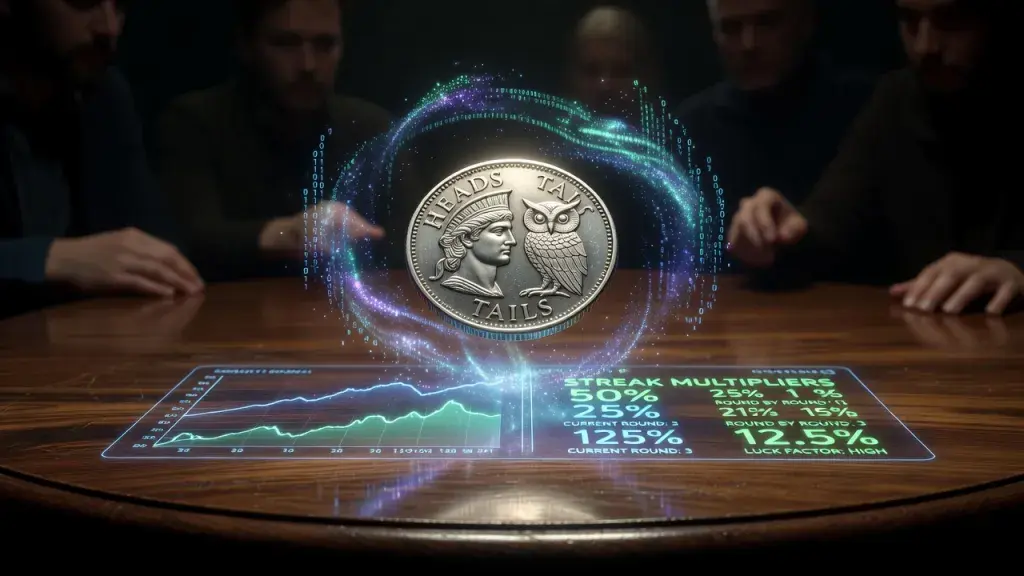
Many versions of this format introduce a progression system. A correct guess allows the player to either cash out or risk the winnings on another flip, doubling potential rewards but also doubling the risk of losing everything accumulated so far. This mechanic transforms a single fifty-fifty decision into a compounding probability curve - each successive flip carries the same individual odds, but the cumulative chance of maintaining a streak drops sharply with every round.
- Round 1: roughly 50% chance of a correct guess
- Round 2 (continuing streak): roughly 25% chance of reaching this point
- Round 3: roughly 12.5% chance of reaching this point
The Psychology Behind a Random Chance Game
People don't engage with coin flips purely for the outcome - they engage for the feeling of standing at a decision point where control has been deliberately surrendered. That surrender is oddly satisfying, and understanding why reveals a lot about why this format has lasted so long.
The Illusion of Pattern in Pure Randomness
Human brains are pattern-detection machines, which creates problems when facing genuine randomness. After several heads in a row, many players instinctively expect tails to "balance things out." This is the gambler's fallacy - the mistaken belief that independent events influence each other. In reality, each flip in a random chance game has no memory of the last. The coin doesn't know it landed on heads three times already.
Why Uncertainty Itself Is the Reward
Behavioral research on decision-making under uncertainty consistently shows that anticipation activates reward-related brain activity even before an outcome is known. This explains why the seconds before a coin lands often feel more charged than the result itself. The unpredictable coin game format exploits this window of tension productively - the suspense is the product, not just the mechanism for producing a winner or loser.
Risk Tolerance and Personal Decision Style
Not everyone responds to a coin toss challenge the same way. Some players stop after one correct guess, satisfied with a modest win. Others chase streaks well past the point of diminishing statistical odds. This divergence says less about the game and more about individual risk tolerance, a trait studied extensively in behavioral economics and directly observable in how people approach any binary-outcome activity.
Strategy, Fairness, and the Limits of Skill
Strategy in a coin toss context is a strange concept, because the outcome cannot be influenced through practice, skill, or study. What can be managed, however, is decision-making around the game itself - when to stop, how much to risk, and how to interpret probability correctly.
There Is No Winning Formula
No betting pattern, alternating guess sequence, or "hot streak" theory changes the underlying fifty-fifty split. Claims of systems that beat a random chance game should be treated skeptically - mathematically, a fair coin toss resists any strategy designed to predict its outcome. The only lever a player actually controls is bankroll management: deciding in advance how much to risk and when to walk away.
What Makes a Platform's Coin Flip Trustworthy
Since the mechanism itself can't be seen the way a physical coin can, trust shifts to transparency. Reputable platforms publish information about their random number generation methods, submit to third-party audits, and display outcome histories that players can review. A trustworthy heads or tails game will show consistent long-term distribution close to fifty percent for each side, even if short-term streaks occasionally favor one outcome.
Setting Personal Limits Before Playing
Because the format escalates quickly through streak mechanics, setting a stopping point beforehand matters more than in slower-paced games. Deciding on a maximum number of consecutive flips, or a fixed amount to risk, keeps the experience enjoyable rather than costly. This single habit does more to protect a player than any theory about lucky patterns or hot hands.
Why the Crazy Luck Game Format Keeps Growing
Simplicity scales well, and few concepts are simpler than a two-outcome guess. That simplicity is exactly why this format continues to attract new audiences across gaming platforms worldwide.
Low Barrier to Entry
Unlike games requiring rule memorization or strategic depth, a coin flip needs no explanation. Anyone who has ever called "heads" as a child understands the entire mechanic instantly. This accessibility makes it an effective entry point for players unfamiliar with more complex chance-based formats.
Fast-Paced Rounds Fit Modern Attention Spans
A single round resolves in seconds. This speed suits an audience accustomed to quick digital interactions, offering immediate feedback rather than the extended wait times associated with other random chance game formats. The rapid cycle of guess, flip, and result keeps engagement high without demanding sustained focus.
The Cross-Generational Appeal of a Familiar Ritual
Because the physical coin toss predates digital entertainment entirely, the crazy luck game format taps into a shared cultural memory. Grandparents and grandchildren alike understand what a coin flip means, which gives digital versions an unusual advantage: they don't need to teach a new concept, only present a familiar one in a new setting.
Frequently Asked Questions
Is a digital coin flip actually random, or can it be manipulated?
Legitimate platforms use certified random number generators tested by independent auditors to confirm fair distribution between outcomes. Manipulation is possible only on unregulated or unaudited sites, which is why checking for third-party certification before playing matters.
Does guessing heads or tails more often improve my odds?
No. Each flip is an independent event with roughly equal odds regardless of past results or which side you favor. Consistently choosing one side over the other has no mathematical effect on the outcome of future flips.
Why do winning streaks feel so much more exciting than a single flip?
Streaks compound anticipation because each successive correct guess raises the stakes while lowering the statistical odds of continuing. This combination of rising reward and shrinking probability creates a sharper emotional response than a single, isolated guess.
Can betting patterns or strategies beat a fair coin toss?
No system reliably beats a truly random fifty-fifty outcome. Any pattern-based approach is a psychological comfort rather than a mathematical advantage, since each flip remains statistically independent of every other.
How is a digital heads or tails game different from flipping a physical coin?
The core probability is the same, but a digital version relies on algorithmic random number generation instead of physics, air resistance, and spin. Visual effects and pacing are added deliberately to recreate the suspense of a physical flip.
What's the safest way to enjoy this type of game without overspending?
Set a fixed budget and a maximum number of rounds before starting, then stick to both regardless of streaks in either direction. This discipline prevents the fast pace and escalating stakes from leading to decisions made purely on emotion.